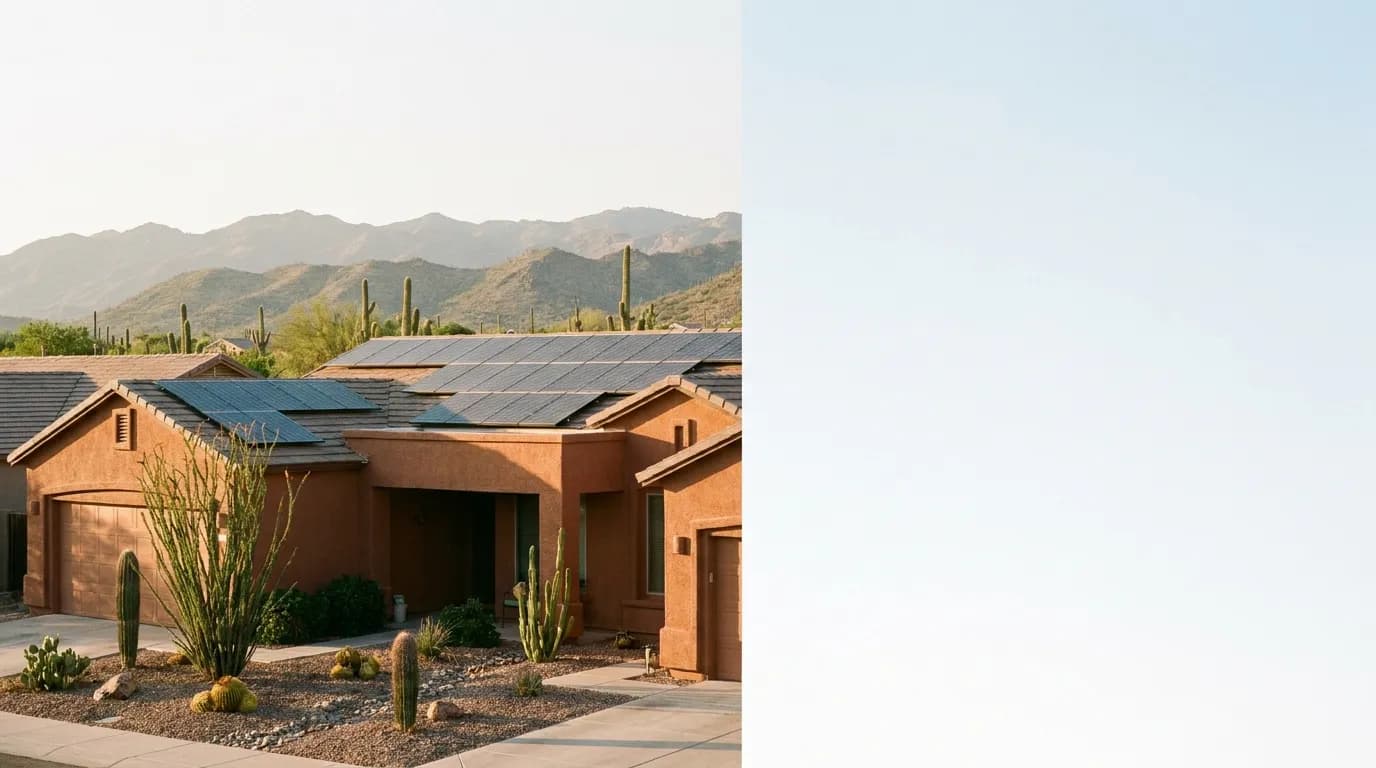
Yes. And you need to bring them the first time you walk into the model home, not the second.
Here is the part nobody says out loud: the person sitting at the desk in that model works for the builder. They are the seller's side of the deal. They are usually pleasant, they know their product cold, and none of that changes who pays them or whose interests they are bound to protect. You can absolutely buy a new home without your own representation. You just need to know that is what you are doing, and you need to decide it before you sign the visitor card.
Out here, this is not a niche situation. It is most of the market.
#Am I buying from the builder's own listing brokerage, or from a broker who represents me?
Almost always the former, in the West Valley.
Of the homes currently for sale in Goodyear that were built in 2025 or later, somewhere between two-thirds and nine in ten are listed by a production builder's own in-house brokerage — the exact share depends on how many single-builder sales offices you count as the builder, which is why I won't print a decimal. Buckeye and Surprise sit in the same range, with Waddell and Peoria close behind. In the city of Phoenix the share falls to well under half. (ARMLS live feed, active listings, snapshot 2026-08-10. I derive the share by matching listing-office names — the direction is solid, the digits are soft.)
The names on those listings are the ones you would expect. Among every active listing in the metro built 2025 or later, Century Communities of Arizona has 229, DRH Properties (D.R. Horton) 207, Richmond American 185, and Meritage Homes of Arizona 159.
So when you walk into a model out here, the odds are you are standing inside a listing office. The builder has a broker. The question is whether you do.
#Do builders pay your agent's commission in Arizona?
Most production builders run a broker co-op program, and in most cases the builder is the one paying your agent. But I am not going to hand you a percentage, and you should be skeptical of anyone who does.
The co-op amount varies by builder, by community, by phase, and by month. It moves with how much standing inventory they are carrying. A builder trying to clear finished specs before quarter close treats it differently than one selling lots off a plat map with a nine-month build.
What matters more than the number:
- Under the buyer-agreement rules in place since 2024, your agent's compensation is written into the agreement between you and them. It is not assumed from the listing anymore. Whether the builder covers it is a term you negotiate, and you settle that before you tour, not after.
- In my experience, production builders here rarely reprice the house for an unrepresented buyer — the price is set by their pro forma and their release schedule, not by whether you brought an agent. If a builder is advertising a credit for coming alone, get that policy in writing and weigh it against what you're giving up. What showing up alone reliably gets you is not a discount. It is no representation.
Have your agent get the builder's current co-op policy in writing before the first appointment. That is a five-minute phone call and it removes the whole argument.
#Is a buyer broker agreement required in Arizona, and can a listing agent show me a house without one?
This is where most of the content online is wrong, including some of it written by agents.
There is no Arizona law that requires you to sign a buyer-broker agreement before you are allowed to look at a house. On May 29, 2026, the Arizona REALTORS® published guidance stating plainly that a listing agent does not need a buyer-broker agreement to allow a prospective buyer to see a house.
One binding flip side, so you hear it from me and not a clipboard: since August 2024, the national MLS rules that bind agents do require an agent who is working with you as a buyer to have a written agreement with you before touring homes together. Arizona statute doesn't demand it — your agent's MLS does. That is exactly what the Show Property form below exists for.
That is not the same as saying agreements do not matter. If you want a broker to represent you, advise you, and negotiate for you, you sign something with that broker. That is the whole mechanism. But "you legally cannot see a house in Arizona without signing" is false, and it gets repeated constantly.
Two different things keep getting conflated:
- The listing side showing you their own listing. No buyer-broker agreement needed.
- Hiring someone to work for you. That takes an agreement, because that is an employment relationship.
#What is the difference between the Arizona "Buyer Broker Agreement to Show Property" and the "Buyer Broker Exclusive Employment Agreement"?
They are two different Arizona REALTORS® forms and they do very different jobs.
The Buyer Broker Agreement to Show Property is the narrow one. It covers a broker showing you specific property for a limited window. It is what you sign when you want to see a house with an agent you have not committed to yet.
The Buyer Broker Exclusive Employment Agreement is the actual hire. It has a term, a geographic scope, a compensation section, and exclusivity, meaning that during the term, that broker is your broker.
Both are negotiable documents. Term length, area, and compensation are all fill-in-the-blank fields on the form, not carved into it. If someone hands you an exclusive agreement with a long term and calls it standard, understand that the term is a blank someone filled in. Read the form. Ask what happens if you want out.
I would rather someone sign the Show Property form, tour three houses with me, and then decide. Confidence should get earned in the car, not on the clipboard.
#What happens when I register at a model home on my first visit without my agent?
You likely give up the ability to bring one into that community's deal.
Nearly every production builder runs a registration policy: your agent has to be present and registered with you on your first visit for the builder to recognize them on that transaction. Some builders allow a short grace window. Many do not. The policy is normally printed on the sign-in card or posted in the sales office, in small type, and it is enforced.
That is the trap, and it is not a scam. The policy is disclosed. It is just disclosed at the exact moment you are distracted by a very nice kitchen.
So if there is any chance you will want your own representation, register with your agent the first time, at each community, before you sign anything or hand over an email address. Undoing it afterward depends entirely on whether the builder feels like making an exception, and you do not want your representation hanging on that.
This is not hypothetical for our team. Across 30 open-house sign-ins we collected, 14 people said they already had an agent, 8 said "no, not yet," 2 answered in a way we could not classify, and 6 skipped the question (Valley Wide Agents sign-in records). Roughly a quarter of the people walking through a door on a Saturday are unrepresented and know it.
#How many homes for sale in Buckeye, Surprise, Goodyear and Waddell were built in 2025 or later?
A lot. This is the densest new-build market in the metro, and it is not close.
As of the August 10, 2026 ARMLS snapshot, 3,371 of the 23,358 active residential listings across the metro were built in 2025 or later. That is 14.4%. Buckeye holds 342 of them and Surprise 354. Those two West Valley cities together hold 696 homes, which is 20.6% of every 2025-or-later active listing in the entire MLS.
By share of each city's own active inventory built 2025 or later:
- Waddell — 56.5% (104 of 184 actives; the median active listing there was built in 2025)
- Buckeye — 37.1%
- Surprise — 30.6%
- Goodyear — 24.3%
- Litchfield Park — 21.1%
- Phoenix — 5.5%
Waddell is the one worth sitting with. More than half of what is for sale there is brand new.
One thing that new inventory almost never has, by the way, is solar — panels out here sit on resale stock, not builder stock, which matters if you're cross-shopping a spec home against a resale with an owned system.
One wording note, because accuracy matters more than a punchy sentence: the MLS feed has no "new construction" checkbox. It has a year-built field. Everything above is "built 2025 or later," which is close to new construction but not identical to it.
#Spec home vs to-be-built: what am I actually choosing between out here?
A spec home, which builders also call inventory or quick move-in, is already framed, finished, or somewhere in between. Finishes are picked. Timeline is short. This is usually where the builder's incentive money is concentrated, because standing inventory costs them every month it sits.
To-be-built means you pick the lot, the plan, and the options. Longer timeline, more control, usually less incentive.
Two practical things:
- The listing data blends them. A 2025-or-later year built includes finished specs, homes still under construction, and genuine 2025 resales, all in one bucket. Right now 92 active listings in the metro carry a completion year of 2027 or 2028, which means they cannot physically exist yet (ARMLS, 2026-08-10). If you are shopping the map on your own, that is part of what you are looking at.
- Options and lot premiums are where a to-be-built budget quietly grows. Price the fully-optioned number before you fall for the base, and know which of those options an appraiser will actually credit.
#How builder incentives and rate buydowns are structured in the West Valley
I am not putting specific numbers on an evergreen page, because incentives change monthly and a stale figure is worse than no figure.
What is true structurally: builder incentives in this market tend to arrive as rate buydowns and closing-cost credits through the builder's affiliated lender rather than as price cuts. A price cut re-comps the whole community and drags every prior buyer's value with it. A buydown does not. That is why the sticker price often looks stubborn while the real deal moves quite a bit.
We track current incentives by community across the West Valley and refresh it. Text me and I will send you what is live this week: (623) 336-6040.
#The thing most people get wrong about this
That walking in alone gets you a better price.
It usually does not — the builder's price is set by their pro forma and their release schedule, and one unrepresented buyer rarely moves it. What an unrepresented buyer gives up, either way, is everything around the price: which lot is worth the premium and which one backs a future arterial, which options hold value at resale and which do not, whether the completion date in the contract has any teeth, what the builder's contract says about their right to change plans and materials, and who is walking the punch list with you at the end.
Two more that come up constantly:
"The builder's agent will look out for me." They may be a genuinely good person and still sit on the other side of the table. That is not a character judgment. It is an org chart.
"I will find an agent later, once I am serious." By then you have registered. See above.
#What to do next
If you are anywhere near touring a model:
- Decide on your representation before your first visit, not after.
- Have your agent register you at every community you plan to see, on the first visit to each one.
- Ask for the builder's current broker co-op policy and incentive sheet in writing.
- Ask what is recorded against the lot beyond the HOA. Nearly all of this inventory has one — assume yes, then go find out what else is attached. Exactly how rare no-HOA is out here, city by city, is counted in our piece on what your Zestimate can't see.
- Look at what is actually listed, not only what is in the model. A large share of the 2025-and-newer inventory in Buckeye and Surprise sits on the open MLS.
You can browse every active listing at vwagents.com/search, or read the market city by city: Buckeye, Surprise, Goodyear.
If you want someone in the room who doesn't work for the builder, that is the job. Call or text (623) 336-6040.
— Charles
Referenced:
- A listing agent does not need a buyer's broker agreement to allow a prospective buyer to see a house — Arizona REALTORS®
- ARMLS listing data via Valley Wide Agents live IDX feed — active snapshot, August 10, 2026 — Valley Wide Agents / ARMLS
Want a straight answer about your move?
See what's on the market right now, save the homes you like, and get a real answer from a local agent — not a call center.